The Language Sequence
The language sequence is the order in which a language is taught over a series of courses at Columbia.
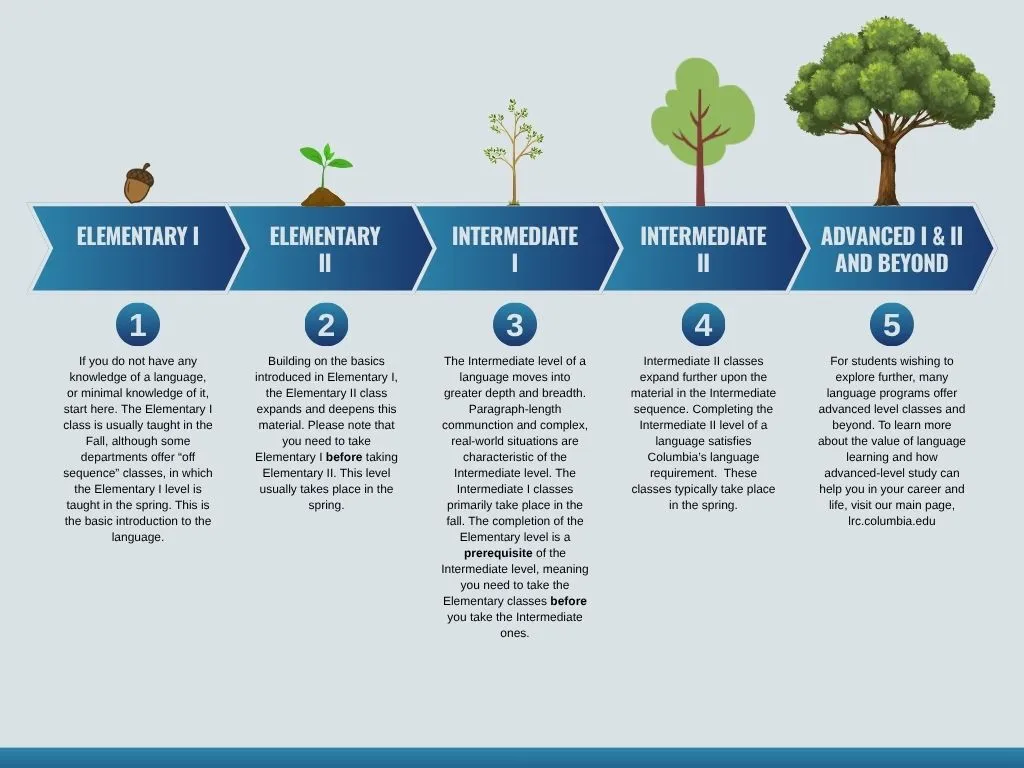
In general, a person who has not studied a language previously would take this sequence of classes:
Elementary I, Elementary II, Intermediate I, Intermediate II, Advanced I, Advanced II.
The content of these classes is cumulative. For example, the content in Elementary II builds on the work done in Elementary I.
Please note: it is not possible to take language courses out of sequence. You must take language classes in order, because each class builds on what the previous class has covered. This is why each class in the sequence has the previous class listed as a prerequisite, except for the Elementary I level.
Some larger language programs may have more detailed pathways for completing the language sequence, in particular with heritage tracks. Please speak with the coordinator of the language you are interested in to confirm the precise sequence of classes for that language.
One way to satisfy the language requirement at Columbia is to satisfactorily complete the second term of an intermediate language sequence. That means four classes: Elementary I, Elementary II, Intermediate I, and Intermediate II. Click here to learn more about the language requirement, as well as proficiency and placement testing.
A prerequisite is a class that you need to take before you take another class. For example, Elementary Spanish II is a prerequisite for Intermediate Spanish I. The Intermediate Spanish I class assumes that you have a grasp on the material in the Elementary Spanish II class. Without having taken Elementary Spanish II, it would not be possible to succeed in Intermediate Spanish I.
If you have previously studied another language, or are a heritage speaker of a language that you would to study formally at Columbia, you may take a placement exam. Please see the Proficiency & Placement Testing page for more information.